2026/10/28 [Wed.] Talking with Your Boss in Japanese Practical Keigo for the Office
リリース発行企業:株式会社クリーク・アンド・リバー社
情報提供:
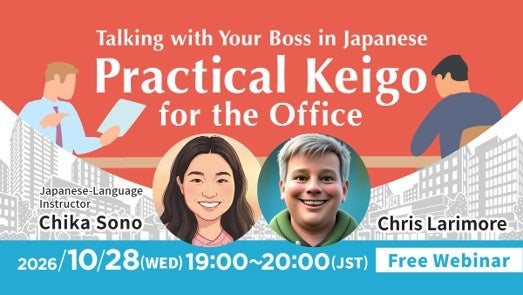
株式会社クリーク・アンド・リバー社(C&R社)は10月28日(水)、日本語を勉強している初心者や中級者の方を対象に、無料のオンラインセミナー「職場で上司と話すときに役立つ敬語(日本語)」を開催します。
CREEK & RIVER Co., Ltd. will hold a seminar on Wednesday, October 28, “Talking with Your Boss in Japanese Practical Keigo for the Office”.
上司と日本語で話すとき、緊張してしまう方も多いのではないでしょうか?言いたいことは分かっていても、適切な敬語のレベルを選ぶのは難しいものです。「です・ます」調、敬語、謙譲語、どれを使えばよいのでしょうか?会話を過度に堅苦しくすることなく、敬意を表すにはどうすればよいのでしょうか?
この1時間のオンラインセミナーでは、日本語講師の園先生が、職場で上司とコミュニケーションをとる際に役立つ実用的な敬語表現をご紹介します。参加者の皆さまは、敬語を単なる文法規則として学ぶのではなく、実際の職場での会話の中でどのように使われているかを学んでいただきます。クリス・ラリモア氏「受講生」としてセミナーに参加し、園先生に質問をしたり、会話の練習を行ったりします。
セミナーでは、上司への挨拶、許可を求める、依頼をする、進捗を報告する、指示に適切に応答するといった、よくある場面を取り上げます。解説は英語で行われ、日本語の例文や指導付きの練習を行う予定です。セミナーは、職場でより自信を持ってプロフェッショナルにコミュニケーションを取りたいと考えている、初級から中級レベルの日本語学習者におすすめの内容です。
Do you feel nervous when speaking Japanese with your boss? You may know what you want to say, but choosing the correct level of politeness can be difficult. Should you use desu/masu, honorific language, or humble language? How can you sound respectful without making the conversation overly formal?
In this one-hour online seminar, Japanese instructor Chika Sono will introduce practical keigo expressions for communicating with your boss in the office. Rather than studying keigo only as a system of grammar rules, participants will see how it is used in realistic workplace conversations. Chris Larimore will join the seminar as the “student,” asking questions and practicing dialogues with Sono-sensei.
The seminar will cover common situations such as greeting your boss, asking for permission, making a request, reporting progress, and responding appropriately to instructions. The explanations will be provided in English, with Japanese examples and guided practice. This seminar is suitable for beginner-to-intermediate Japanese learners who want to communicate more confidently and professionally at work.
<What You Will Learn>
・When and why keigo is used in Japanese workplaces
・How to choose an appropriate level of politeness when speaking with your boss
・Useful expressions for asking permission and making requests
・Polite ways to report progress or explain a problem
・Natural responses when your boss gives you instructions
・Common keigo mistakes made by Japanese learners
<Recommended for People Who>
・Work-or hope to work-in a Japanese-speaking office
・Understand basic Japanese but find keigo difficult
・Are unsure how formally to speak with a boss
・Want practical workplace expressions rather than grammar explanations alone
・Would like to sound more respectful and professional in Japanese
・Want to learn through realistic dialogues and guided practice
Talking with Your Boss in Japanese Practical Keigo for the Office
■Date and time2026/10/28(WED) 19:00~20:00 (JST)
■Place
Zoom
■登壇者

Chika Sono
Graduated from Meisei University with a degree in Education, specializing in Elementary Education. Completed a 420-hour Japanese Language Teacher Training Program. While at university, worked at YSC Global School, providing Japanese language education and academic support to children and young people with international backgrounds. After graduation, taught Japanese to elementary school students at a public Japanese immersion school in Oregon, USA. Passionate about making Japanese lessons fun, easy to understand, and enjoyable. Values creating a supportive learning environment where students can feel comfortable and confident using Japanese.
Enjoys traveling, both in Japan and abroad.

Chris Larimore
BA in English Literature, Hendrix College (Arkansas)
MA in English Literature, University of Mississippi (Mississippi)
20 years of experience working for global language companies
Has taught a wide range of classes, including corporate training, university courses, children’s lessons, and TOEIC preparation. Currently manages language education operations at CREEK & RIVER Co., Ltd., focusing on English instruction for Japanese speakers and Japanese instruction for non-native speakers. Originally from the U.S., he moved to Japan about 30 years ago and lives in a traditional “shitamachi” (old downtown) neighborhood of Tokyo with his wife, son, daughter, and two pet turtles. He enjoys American football, craft beer, Japanese history, and local neighborhood festivals.
■Entry fee
Free
■Capacity
60 people
▼Details and Application
https://www.creativevillage.ne.jp/category/crv_event/179742/
※Application deadline:2026/10/28(WED) 20:00(JST)
[About C&R Group]
The C&R Group, including CREEK & RIVER Co., Ltd., is active in 18 fields: TV/movies, games, web, advertising/publishing, artists/authors, medical, IT, legal, accounting, architecture, fashion, food, computer science, performing arts, life sciences, athletes, CXO, and agriculture. We provide an environment for professionals to maximize their potential through the provision of jobs, the composition of projects, the monetization of copyrights and intellectual property, and educational opportunities. We also aim to contribute to the value creation of our clients through the abilities of professionals.
Web:https://www.cri.co.jp/
X:https://x.com/creekcrv
Facebook:https://www.facebook.com/creekandriver
note:https://note.com/creek
LinkedIn:https://www.linkedin.com/company/cr.creekandriver
YouTube: https://www.youtube.com/channel/UCS9MHzddqWKsOAgmUnTgxIg
特集




最新ニュース


暮らす・働く

買う

食べる


見る・遊ぶ



みん経トピックス
プレスリリース/東京都